
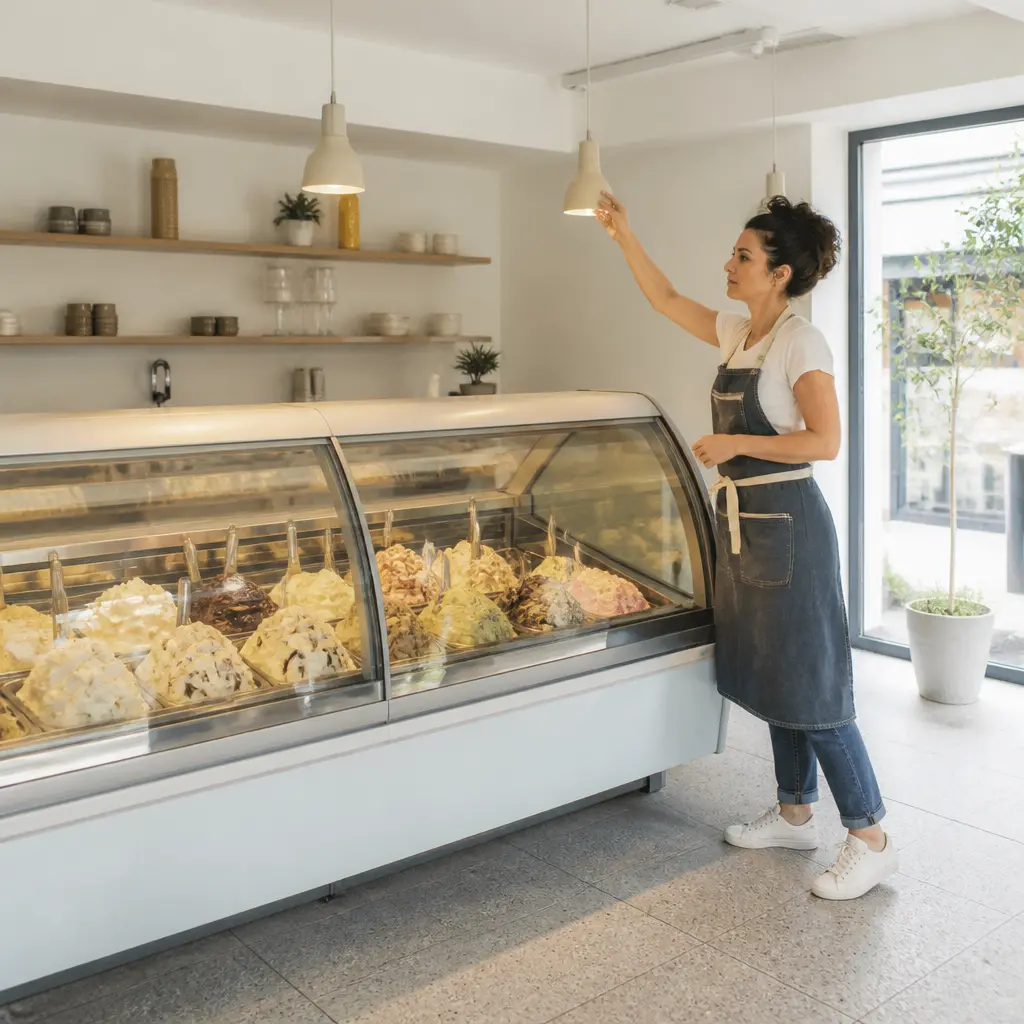
Warm lighting is a display-lighting strategy that uses lower correlated color temperatures (CCT), typically about 2700–3000 kelvins, to create an inviting atmosphere while making many gelato colors appear rich and appetizing. The strongest results come from pairing warm white LEDs with high color-rendering quality, controlled brightness, low glare, and careful testing of delicate shades such as pistachio, lemon, mint, berry, and cream. The Illuminating Engineering Society distinguishes color temperature from color rendering: CCT describes whether light appears visually warm or cool, while color rendering describes how accurately illuminated objects appear compared with a reference source. Because LEDs generally use at least 75% less energy and last up to 25 times longer than incandescent lamps, according to ENERGY STAR, the right lighting choice can improve both presentation and operating efficiency.
Improves Gelato Color Appeal: Warm Lighting and Color Rendering
Warm lighting and gelato color rendering describe the relationship between a lamp’s spectral output and the way customers perceive gelato inside a display case. The Commission Internationale de l’Éclairage defines color rendering as the effect of an illuminant on the color appearance of objects compared with a reference illuminant. In practical terms, a lamp with attractive warmth but weak spectral coverage may make gelato look dull, gray, overly yellow, or less distinct.
The key characteristics are CCT, color-rendering index, red rendering, spectral distribution, illuminance, glare control, and the interaction between light and the display case glass. Warm white light around 2700–3000 K usually complements chocolate, caramel, hazelnut, coffee, vanilla, and baked dessert tones. A slightly less amber 3000–3500 K source can better preserve the freshness of lemon, fruit, yogurt, and green flavors while still creating a welcoming environment.
Correlated Color Temperature Defines the Visual Warmth
Correlated color temperature is a measurement in kelvins that describes the hue of a light source relative to a theoretical blackbody radiator. Lower values look warmer and more amber; higher values look cooler and bluer. CCT does not indicate whether a lamp reproduces gelato colors accurately. Two 3000 K LEDs can produce noticeably different results because their spectral distributions differ.
For a traditional Italian-style gelateria, 2700–3000 K is often a useful starting range for the customer-facing area. However, very warm 2200–2400 K lamps can push white, cream, and pale green gelato toward yellow. A 3000 K or 3500 K source may therefore be more suitable when the menu emphasizes fruit sorbets and clean pastel colors.
Color Rendering Index Protects Flavor Recognition
The color rendering index, or CRI, estimates how faithfully a light source reveals a set of standardized colors compared with a reference illuminant. A CRI of 80 is a common minimum for general commercial lighting, but gelato presentation benefits from products rated CRI 90 or higher. High CRI alone is not a guarantee: the traditional CRI calculation does not fully describe saturated reds, pinks, and oranges, which are important for strawberry, raspberry, mango, and blood-orange flavors.
Retail designers should also examine the R9 value, which evaluates strong red rendering, and, when available, the TM-30 measures Rf and Rg. Rf indicates fidelity, while Rg indicates whether colors appear more muted or more saturated. A high-quality display specification might begin with CRI 90+, strong R9 performance, and TM-30 data that does not excessively desaturate fruit colors. These are selection targets rather than universal legal requirements.
Balances Atmosphere and Accuracy: Warm Lighting for Gelato Displays
Once color quality is established, the next predicate is balance: warm lighting should support the emotional character of the shop without distorting the product. Lighting designers commonly separate ambient illumination, task illumination, and accent illumination. A gelato case needs enough vertical and internal light to reveal each pan, while the surrounding room can use warmer decorative fixtures to create comfort.
High-CRI LED Case Lighting Reveals Fine Color Differences
LED strips, linear modules, and recessed case fixtures are practical choices because they provide directional control, low heat compared with many legacy sources, and flexible color-quality specifications. Fixtures should be selected for food-display environments and positioned to illuminate the front and surface of the gelato rather than the viewer’s eyes.
The U.S. Department of Energy notes that LED performance depends on factors including efficacy, thermal management, and optical design. In a gelato case, those factors matter because poor heat control can shorten component life, while exposed hotspots can create bright bands across the pans. Diffusers and even spacing help produce consistent color from one flavor to the next.
Glare and Reflections Preserve Product Visibility
Glare is excessive brightness or contrast that reduces visual comfort and makes details harder to see. In a glass-front case, an incorrectly aimed spotlight may reflect the ceiling, menu board, or customer directly into the viewing angle. Anti-glare optics, shielded fixtures, matte interior surfaces, and controlled beam angles can make the gelato appear clearer without simply increasing brightness.
A useful on-site test is to view the case from the entrance, ordering position, and seated area during both daytime and evening conditions. Check whether pale flavors remain distinct, whether red fruit colors look lively rather than purple, and whether the glass creates distracting reflections. A simple comparison photograph taken with the same camera settings can support a before-and-after evaluation, although visual judgment under the actual shop lighting remains essential.
Enhances Specific Gelato Shades: Warm Lighting and Flavor Categories
Cream, Vanilla, and Pistachio Need Controlled Warmth
Cream and vanilla benefit from a warm atmosphere, but excessive amber light can make them appear muddy or artificially yellow. Pistachio requires particular care because its color may shift from fresh green toward olive. A 3000 K high-CRI LED with strong green and red balance is generally safer than an extremely warm lamp. The final choice should be judged using the actual recipe, because natural pistachio, flavor paste, and food coloring produce different reflectance characteristics.
Fruit Sorbets Need Red and Blue Spectral Support
Strawberry, raspberry, cherry, mango, and citrus sorbets rely on saturated colors to communicate freshness. Strong R9 performance can help preserve red and orange appearance, while adequate short-wavelength output helps prevent blue, lavender, and mint shades from looking lifeless. For a case dominated by fruit flavors, neutral-warm 3000–3500 K lighting may outperform a candle-like 2700 K scheme.
Chocolate and Coffee Respond Well to Rich Warm Light
Chocolate, coffee, gianduja, and caramel often look appealing under warm light because amber and red components reinforce their brown and golden visual cues. The risk is loss of separation between neighboring dark flavors. High-quality optics, moderate brightness, and contrasting labels or pan surrounds can preserve visual distinction without making the display feel clinical.
Guides Gelato Merchandising: Warm Lighting Selection and Testing
A practical specification should evaluate the complete lighting system rather than relying on the phrase “warm white.” Record CCT, CRI, R9, TM-30 data when available, wattage, beam angle, glare control, dimming compatibility, and operating temperature. ENERGY STAR’s efficiency benchmarks demonstrate why LED conversion can reduce energy demand, but efficiency should not be considered separately from color quality and maintenance access.
- Choose two or three sample fixtures between 2700 K and 3500 K.
- Install them temporarily at the intended height and angle.
- Evaluate representative light, medium, dark, fruit, cream, and green flavors.
- Inspect the case from normal customer viewpoints during day and night.
- Measure glare and compare color consistency across the full display.
- Select the lowest-energy option that preserves the desired appearance and readability.
A small tasting-room or shop case can serve as a real-world pilot. For example, a display emphasizing pistachio, lemon, strawberry, chocolate, and vanilla could compare 2700 K and 3000 K high-CRI LEDs. The warmer option may create a more intimate mood, while the 3000 K option may produce clearer separation among pale and fruit-based flavors. Documenting customer comments, product photography, sales by flavor family, and staff observations over several weeks provides stronger evidence than judging the lamps in an empty showroom.
Conclusion: Warm Lighting and Gelato Color Rendering Create a More Persuasive Display
Warm lighting can make a gelateria feel welcoming and can enrich chocolate, coffee, caramel, and cream tones, but CCT alone does not guarantee attractive gelato color. High-CRI LEDs, strong red rendering, balanced spectral output, glare control, and careful case testing are the connected attributes that produce reliable results. The most effective approach is to compare 2700–3500 K samples against the actual gelato menu, then measure both visual quality and operating efficiency.
Owners, designers, and equipment suppliers should request complete photometric data instead of choosing fixtures by appearance or color-temperature label alone. Further reading from the Commission Internationale de l’Éclairage, the Illuminating Engineering Society, the U.S. Department of Energy, and ENERGY STAR can help teams build a lighting specification that protects product accuracy while strengthening atmosphere and merchandising.
Sources: Commission Internationale de l’Éclairage, Colorimetry and Colour Rendering resources, https://cie.co.at/; Illuminating Engineering Society, The Lighting Handbook, https://www.ies.org/; U.S. Department of Energy, Solid-State Lighting and LED Basics, https://www.energy.gov/; ENERGY STAR, LED Lighting, https://www.energystar.gov/products/lighting_fans/light_bulbs; DesignLights Consortium, Technical Requirements for Quality LED Lighting, https://www.designlights.org/