
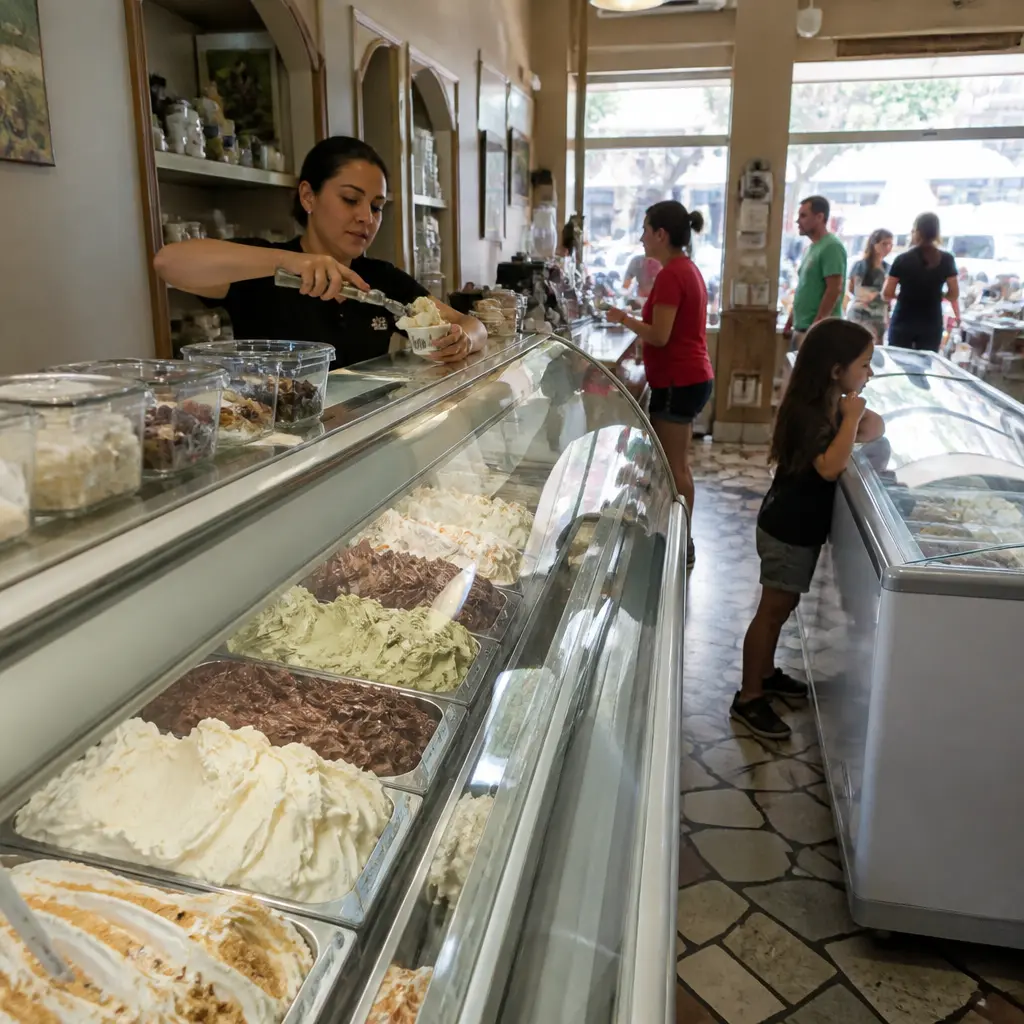
American ice cream and Italian gelato are frozen dairy desserts built from similar ingredients, but they express two different production philosophies. American ice cream typically incorporates substantially more air, called overrun, while gelato is churned more slowly and served slightly warmer to preserve a dense, elastic texture. The contrast reflects U.S. industrial scaling, legal standards, freezer technology, and consumer expectations on one side, and Italian artisanal practice, restrained overrun, and flavor intensity on the other. The difference matters commercially as well as sensorially: air affects serving volume, perceived richness, melting behavior, ingredient costs, and the number of portions produced from a batch.
Air Incorporation Defines American Ice Cream and Gelato Density
Overrun is the percentage increase in frozen-dessert volume caused by incorporating air during churning. If 100 liters of mix becomes 150 liters of finished product, the dessert has 50% overrun. Food scientists use overrun to distinguish texture, weight, melting rate, and production economics across frozen desserts.
American ice cream commonly falls within a broad range of roughly 25% to 100% overrun, depending on whether it is premium, standard, economy, or soft-serve product. Gelato generally contains about 20% to 30% overrun in artisanal production. These are practical industry ranges rather than universal legal limits: recipes, machines, stabilizers, fat levels, and retailer requirements can move the figures higher or lower.
American Ice Cream Uses Overrun as a Product Attribute
American ice cream is a frozen dessert whose identity combines a churned dairy mix with a relatively high degree of air incorporation. The U.S. Food and Drug Administration defines ice cream through compositional requirements, including at least 10% milkfat for ordinary ice cream, although products marketed as low-fat, reduced-fat, or nonfat follow different categories and standards.
Air creates a lighter spoon feel and increases the finished volume available for sale. In mass production, that can lower the ingredient cost per fluid ounce and make scoops appear generous. It also supports familiar American textures: easy scooping, a soft bite after tempering, and a comparatively fluffy melt.
The main hyponyms of American ice cream include premium ice cream, superpremium ice cream, standard ice cream, economy ice cream, soft-serve, frozen custard, and light ice cream. Premium and superpremium products usually reduce overrun and increase milkfat or egg yolk, while economy products often rely more heavily on air and stabilizer systems. Frozen custard adds a prescribed or customary level of egg yolk, producing a richer body even when its air content resembles some ice creams.
Italian Gelato Treats Low Overrun as a Texture Principle
Gelato is an Italian-style frozen dessert made from a mix that may contain milk, cream, sugar, water, and flavor ingredients, then frozen under conditions designed to produce a dense, smooth body. Unlike American ice cream, “gelato” does not function as one fully harmonized legal category across all markets. In practice, Italian gelato is identified by production style, serving temperature, composition, and texture as much as by a single statutory formula.
Lower overrun leaves more of the product’s mass in each spoonful. Gelato therefore tends to feel compact, stretchy, and intensely flavored. Its lower serving temperature, commonly around 10 to 15 degrees Fahrenheit rather than the colder storage temperature of packaged ice cream, also makes it seem softer and more aromatic. The warmer service condition allows volatile flavor compounds to reach the nose more readily, although it also shortens the product’s ideal display life.
Gelato’s related categories include milk-based gelato, fruit sorbetto, nut gelato, chocolate gelato, and water-based granita. Sorbetto is not simply dairy-free gelato: it is generally built around water, sugar, fruit, or other flavorings and has a different balance of solids, acidity, and freezing behavior. Semifreddo is another related Italian dessert, but it is a partially frozen confection rather than ordinary gelato and often contains whipped cream or meringue.
Industrial Freezing Encouraged American Ice Cream to Add Air
The American preference for aerated ice cream developed alongside continuous freezing, mechanized distribution, and national retail. Batch freezers and later continuous freezers could control the rate at which mix was frozen while beaters scraped ice crystals from a cold surface. The same agitation dispersed air bubbles through the partially frozen mix, making overrun a controllable manufacturing variable rather than an accidental by-product.
Continuous Freezers Made Volume Scalable
A continuous freezer allows a factory to feed liquid mix into one end and withdraw semi-frozen product continuously. Compared with small batch production, this system improves throughput, consistency, and sanitation control. It also makes it practical to regulate air injection, freezing time, draw temperature, and product density across very large quantities.
This technology aligned with the American grocery model, in which ice cream moved through manufacturing plants, refrigerated warehouses, delivery routes, supermarket freezers, and home freezers. A product with more overrun could be packaged in visually substantial containers while reducing the amount of dairy solids required for each unit of volume. The result was not merely a cheaper dessert; it was a dessert adapted to long supply chains and standardized portioning.
U.S. Standards Rewarded Familiar Ice Cream Categories
U.S. food standards shaped the language consumers saw on packages. The FDA standard for ice cream specifies compositional features such as milkfat, milk solids, and weight per gallon, while labeling rules distinguish ice cream from frozen dairy desserts and reduced-fat products. These standards do not require one particular overrun percentage, but they created a stable commercial category in which manufacturers could compete through fat level, air content, sweetness, mix-ins, and price.
The category structure encouraged segmentation. A supermarket could carry economy tubs, family-size standard products, premium pints, superpremium brands, frozen custard, and soft-serve mixes. Air became one of several hidden engineering levers behind those distinctions. Consumers often judged value by container size and scoop appearance, while manufacturers balanced overrun against ingredient cost, package claims, and texture expectations.
Italian Gelato Stayed Dense Through Craft Production and Service Culture
Italian gelato evolved in a setting where freshness, local production, and immediate service were more important than shipping a highly standardized frozen product across a continent. Artisanal gelaterias generally make smaller batches, display the product in service cases, and replenish flavors frequently. This environment favors a dense product whose appeal depends on visible ingredients, strong flavor identity, and a smooth texture at serving temperature.
Slow Churning Limits Air and Controls Ice Crystals
Gelato machines typically churn at lower speeds than many industrial ice-cream systems, so they incorporate less air. The mix is also frozen while being scraped and agitated, producing small ice crystals when the process is properly controlled. Small crystals are essential to smoothness, but low overrun is not by itself a guarantee of quality: poor formulation, temperature fluctuation, or extended storage can still create coarse texture.
Gelato formulas also commonly use less cream and less milkfat than rich American ice cream, although the range is wide. Lower fat can make delicate fruit, coffee, chocolate, and nut flavors taste clearer rather than coating the palate with heavy dairy fat. Sugar and other dissolved solids remain crucial because they depress the freezing point and help maintain a pliable texture.
Warmer Display Temperature Amplifies Flavor and Softness
Gelato is usually served warmer than hard-pack American ice cream. At that temperature, the frozen phase is less rigid, the spoon cuts more easily, and aroma is released more effectively. The warmer display also explains why gelato is often stored in covered or partially covered pans rather than exposed in tall, sculpted mounds: limiting air exposure and temperature swings helps reduce melting, oxidation, and recrystallization.
The service model reinforces portion density. A gelato scoop or spatula portion may be smaller in volume than a lofty American scoop but heavier for its apparent size. For that reason, comparing prices by container volume alone can be misleading. Weight, overrun, fat content, sugar concentration, and serving temperature all influence the consumer’s perception of value.
Air, Fat, Sugar, and Temperature Work Together
Overrun is only one variable in frozen-dessert structure. A useful comparison must also consider fat, milk solids, sugar, stabilizers, emulsifiers, freezing rate, storage temperature, and the size of ice crystals. Two products with the same overrun can taste very different if one has more fat, more egg yolk, a different sugar blend, or a more effective stabilizer system.
Air Changes Perceived Richness and Melting
Air bubbles interrupt the continuous frozen matrix and make a dessert feel lighter. They can also slow or alter heat transfer because air is a poor conductor compared with water and ice. However, melting quality depends on the entire emulsion and stabilizer system. A dense gelato can melt quickly because it is served warmer, while a well-formulated ice cream with more air can retain its shape for a surprisingly long time.
Fat contributes creaminess by lubricating the palate and helping stabilize air cells. Milk proteins and emulsifiers help organize the interface between fat, water, and air. Sugars control sweetness but also keep more water unfrozen. Stabilizers such as guar gum, locust bean gum, and carrageenan bind water and limit ice-crystal growth. These interactions explain why “more air” does not simply mean “worse,” and why “denser” does not automatically mean “more authentic” or “higher quality.”
Overrun Changes Economics as Well as Eating Quality
Because overrun increases volume without adding an equal mass of ingredients, it affects cost calculations, package size, freight, and portion yield. A 100% overrun product contains approximately half as much mix by volume as a zero-overrun product, although real formulations and manufacturing conditions complicate the exact comparison. Low-overrun gelato therefore places greater pressure on ingredient quality, batch turnover, temperature management, and pricing by weight or portion.
A useful chart for readers would compare four measures across standard American ice cream, premium ice cream, artisanal gelato, and sorbetto: approximate overrun, typical fat level, serving temperature, and dominant texture. Such a chart should label the figures as ranges because recipes vary by producer and national standards do not define every style identically.
The American and Italian Models Are Converging
Modern dessert markets increasingly borrow from one another. American premium brands advertise lower overrun, denser texture, and small-batch methods, while Italian gelaterias use blast freezers, computerized batch control, and carefully engineered stabilizer systems. U.S. shops often market “gelato” as a premium experience, and Italian producers may package frozen desserts for retail distribution using technologies associated with American manufacturing.
The distinction remains useful because it describes tendencies rather than rigid national rules. A high-quality American ice cream may be dense and intensely flavored, and an industrially produced gelato may contain more air than an artisanal product. The most reliable questions are practical: How much air was incorporated? What is the fat and sugar balance? At what temperature is it served? How quickly was it made, frozen, and sold?
Conclusion: American Air and Italian Density Reflect Different Systems
American ice cream added air because industrial freezers, national distribution, package economics, and consumer expectations made overrun a valuable product attribute. Italian gelato stayed comparatively dense because artisanal production, frequent local service, lower churning intensity, warmer display temperatures, and flavor-forward formulas rewarded compact texture. The central entity-attribute pairing is therefore clear: American ice cream is commonly associated with higher overrun, while Italian gelato is commonly associated with lower overrun and greater density.
Neither approach is inherently superior. Air can create lightness, scoopability, and commercial efficiency; density can deliver concentration, elasticity, and a stronger impression of flavor. Readers comparing products should look beyond country labels and evaluate overrun, fat, sugar, stabilizers, storage, and serving temperature. Further reading in FDA frozen-dessert standards, food-science texts on ice-cream structure, and professional gelato-production manuals can provide a more precise understanding of how formulation and machinery shape the final spoonful.
Sources: U.S. Food and Drug Administration, 21 CFR Part 135—Frozen Desserts, https://www.ecfr.gov/current/title-21/chapter-I/subchapter-B/part-135; U.S. Food and Drug Administration, Food Labeling Guide, https://www.fda.gov/food/food-labeling-nutrition/food-labeling-guide; International Dairy Foods Association, Ice Cream and Frozen Desserts, https://www.idfa.org/consumer-products/ice-cream-and-frozen-desserts; Goff, H. Douglas and Hartel, Richard W., Ice Cream, 7th Edition, Springer, https://link.springer.com/book/10.1007/978-1-4614-6096-4; Marshall, Robert T., Goff, H. Douglas, and Hartel, Richard W., Ice Cream, 6th Edition, Springer, https://link.springer.com/book/10.1007/978-1-4615-0163-3; Carpigiani Gelato University, Gelato Production and Technical Resources, https://www.gelatouniversity.com/.