
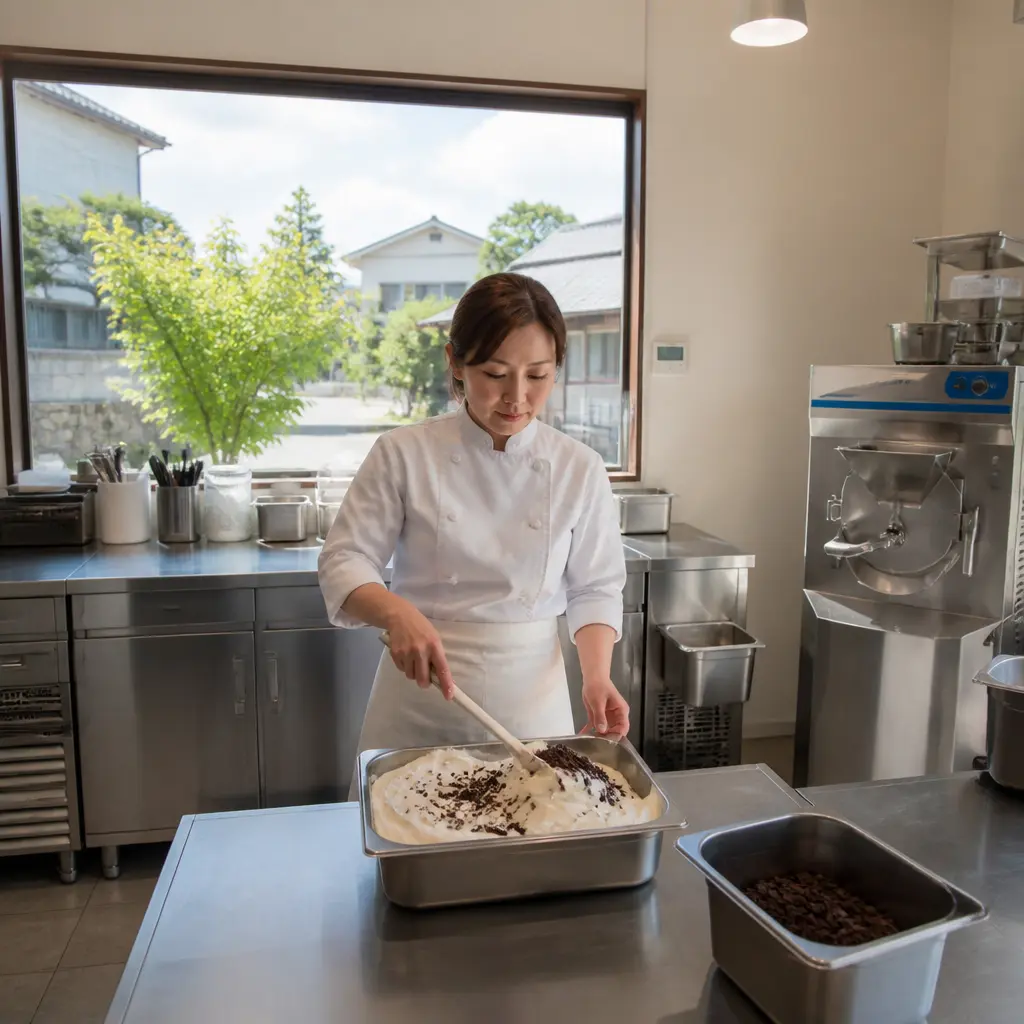
Vanilla gelato is a dense, low-overrun frozen dessert in which milk, cream, sugar, and vanilla provide a smooth, aromatic base; rich chocolate pieces are inclusions that add bitterness, cocoa aroma, and textural contrast. The most successful balance depends on controlling sweetness, cocoa intensity, piece size, water migration, and serving temperature rather than simply adding more chocolate. Because gelato is commonly served warmer and with less incorporated air than traditional ice cream, its flavor and texture can feel especially concentrated. A useful formulation target is roughly 8–15% chocolate inclusions by weight, adjusted for the chocolate’s sweetness and the desired level of crunch. This article explains how texture contrast, flavor intensity, particle size, and storage stability work together to create a silky vanilla base with distinct but harmonious chocolate pieces.
Chocolate Pieces—Texture Contrast in a Silky Vanilla Gelato Base
Chocolate pieces create texture contrast when a crisp, brittle, or chewy element interrupts an otherwise smooth frozen matrix. Food scientist H. Douglas Goff and confectionery specialist Richard W. Hartel describe frozen-dessert quality as a balance among ice crystals, air cells, fat structure, and unfrozen water. In practical terms, the chocolate must remain perceptible without making the gelato feel hard, waxy, or fragmented.
The main hyponyms of chocolate-piece texture contrast include chocolate flakes, mini chips, chopped couverture, cacao nibs, fudge nuggets, and stracciatella-style ribbons. Each behaves differently. Thin flakes fracture quickly, mini chips provide repeated bursts of crunch, chopped chocolate offers irregular sensory variation, cacao nibs contribute bitterness and dryness, and fudge pieces deliver a softer chew. The best choice depends on whether the intended experience is delicate, crisp, intense, or indulgent.
Silky Vanilla Base—Smoothness and Aroma Delivery
A silky vanilla base is a gelato mix with very small ice crystals, a stable fat-and-protein structure, and enough dissolved sugar to remain scoopable. “Silky” is not merely a visual description: it reflects the interaction of crystal size, viscosity, emulsification, and serving temperature. Goff and Hartel note that smaller ice crystals and well-distributed air cells are central to a smooth frozen-dessert perception.
Gelato generally contains less incorporated air than American-style ice cream. Commercial gelato often has approximately 20–30% overrun, while some ice creams may reach 50% or more, depending on the product and manufacturing method. Less air makes the vanilla flavor feel fuller and gives chocolate pieces a more immediate textural impact. For that reason, a vanilla base that tastes pleasantly mild before freezing may seem comparatively sweet or intense after chocolate is added.
Vanilla Flavor—Aromatic Counterweight to Cocoa
Vanilla functions as an aromatic counterweight rather than simply another sweet flavor. Vanillin and related aromatic compounds provide floral, creamy, and caramel-like impressions that soften cocoa’s bitterness. Nielsen-Massey and other vanilla producers distinguish among extracts, pastes, and whole beans, but the sensory principle is consistent: a clear vanilla aroma helps the base remain identifiable when chocolate intensity rises.
For balance, use enough vanilla to remain noticeable after freezing, but avoid turning the base into a strongly perfumed dessert. Whole vanilla bean or paste can provide visible seeds and a rounded aroma, while pure extract is convenient but may taste sharper if added excessively. A small amount of salt can increase perceived sweetness and reduce harsh cocoa bitterness without making the gelato taste salty.
Chocolate Intensity—Cocoa Richness and Sweetness Control
Chocolate intensity is the combined effect of cocoa solids, cocoa butter, sugar, roasting, particle size, and the amount included in the gelato. Dark chocolate with 60–70% cocoa solids usually supplies a clear cocoa profile while retaining enough sugar to complement vanilla. Chocolate above 70% can produce a more adult, bitter flavor, particularly when paired with cacao nibs or a low-sugar base.
The percentage printed on a chocolate label refers primarily to total cocoa content, not directly to bitterness. Two chocolates with the same cocoa percentage can differ substantially because of roast level, bean origin, conching, sugar type, and cocoa-butter composition. Taste the chocolate alone and again when frozen before selecting the final inclusion.
Piece Size—Perceived Crunch and Distribution
Piece size determines how quickly chocolate releases flavor and how evenly it appears in each spoonful. Pieces around 2–4 millimeters create frequent, integrated bites; pieces around 5–8 millimeters provide a more pronounced crunch but can overpower a delicate base. Very large pieces may feel excessively hard at freezer temperature and can cause uneven distribution during storage.
Distribution matters as much as size. A practical inclusion level is approximately 8–15% of the finished gelato, although a thin stracciatella ribbon may use less chocolate while a chunk-heavy product may use more. The number should be adjusted according to density: cacao nibs and solid chocolate occupy different volumes at the same weight. A simple production check is to sample the first, middle, and last portions of a container to confirm that the pieces have not settled or clumped.
Chocolate Type—Flakes, Chips, Nibs, and Fudge Pieces
Thin chocolate flakes are ideal when the goal is rapid melting and a delicate snap. Mini chips maintain a more distinct crunch, while chopped couverture creates irregular pieces with varied melt behavior. Cacao nibs are less sweet and more brittle; they add roasted complexity but should be used carefully because their bitterness and dry finish can compete with vanilla.
Fudge or brownie-style pieces create a softer, more indulgent contrast, but their moisture can migrate into the surrounding gelato. This may produce sogginess, icy patches, or a gummy texture during storage. For a stable product, use inclusions formulated for frozen desserts or coat moisture-sensitive pieces with a thin layer of chocolate or cocoa butter.
Serving Temperature—Melt Rate and Flavor Balance
Serving temperature changes both the vanilla base and the chocolate pieces. Gelato is often displayed and served at approximately −12 to −14 degrees Celsius, whereas hard-frozen ice cream is commonly stored closer to −18 degrees Celsius. At the warmer gelato temperature, the base becomes more aromatic and scoopable, while chocolate softens slightly and releases flavor more quickly.
If the pieces remain unpleasantly hard, reduce their size, select a chocolate with a softer fat phase, or allow a short tempering period before serving. If they become greasy or lose their snap, the formulation or storage temperature may be too warm. The International Dairy Foods Association identifies temperature control as a central factor in preserving frozen-dessert quality, because fluctuations promote ice recrystallization and texture loss.
Storage Stability—Preventing Ice Crystals and Moisture Migration
Storage stability is the ability of the gelato to retain smoothness, flavor, and inclusion texture over time. Repeated temperature fluctuation encourages ice crystals to grow, producing a coarse mouthfeel. Moisture migration can also soften chocolate coatings or dry out inclusions, particularly in pieces containing cake, cookie, fruit, or caramel.
- Use an airtight container with minimal headspace to reduce dehydration and odor absorption.
- Freeze the finished gelato quickly and keep the storage temperature as constant as possible.
- Fold in chocolate pieces near the end of churning so they remain distributed without excessive breakage.
- Prefer smaller pieces when the product will be stored for several days or subjected to repeated service.
- Label the batch with production date and recommended quality window; artisanal gelato is generally best when consumed fresh.
Flavor Balance—Sweetness, Bitterness, Fat, and Salt
Flavor balance means that no single component dominates the entire bite. Chocolate contributes bitterness, roast, and fat; vanilla contributes aroma and perceived creaminess; sugar suppresses bitterness; and salt increases flavor definition. Because freezing reduces the perception of sweetness and aroma, the unfrozen mix should be evaluated both before freezing and after a properly chilled sample has been tasted.
A useful sensory sequence is to taste the base alone, then taste a spoonful containing both base and chocolate, and finally taste the product after it has warmed slightly in the mouth. If the first impression is mostly sugar, reduce the base sweetness or choose darker chocolate. If the finish is dry or bitter, use a sweeter chocolate, reduce nibs, increase vanilla aroma, or add a carefully measured amount of salt. If the base disappears entirely, decrease the inclusion percentage or use finer flakes.
A Practical Test Batch—Adjusting by Sensory Evidence
For a controlled trial, prepare three small batches with the same vanilla gelato base and different chocolate inclusion levels, such as 8%, 12%, and 16%. Keep piece size and chocolate type constant. Record scoopability, first-bite texture, vanilla recognition, cocoa intensity, sweetness, bitterness, and aftertaste on a five-point scale. This approach separates the effect of quantity from the effect of chocolate style.
A simple comparison chart can plot inclusion percentage on the horizontal axis and perceived chocolate intensity on the vertical axis, with a second line for vanilla recognition. The ideal formulation is not necessarily the point with the highest chocolate intensity; it is the point where chocolate is clearly present while vanilla remains recognizable and the base still feels smooth.
Conclusion—Chocolate Contrast and Vanilla Smoothness
Chocolate pieces—texture contrast work best when their size, quantity, sweetness, and melt behavior support the silky vanilla base rather than compete with it. A dense gelato with approximately 20–30% overrun delivers concentrated flavor, so moderate inclusion levels, aromatic vanilla, and careful temperature control are especially important. Dark chocolate, flakes, chips, nibs, and fudge pieces offer distinct sensory outcomes, while moisture management protects quality during storage.
For further development, make a three-level test batch, evaluate it at serving temperature, and record both texture and flavor results. This evidence-based process is more reliable than adjusting chocolate by appearance alone and can guide a final recipe for home production, an artisan gelateria, or a larger frozen-dessert operation.
Sources: H. Douglas Goff and Richard W. Hartel, Ice Cream, 7th Edition, Springer, https://link.springer.com/book/10.1007/978-1-4614-6096-1; International Dairy Foods Association, Ice Cream and Frozen Desserts, https://www.idfa.org/ice-cream; U.S. Food and Drug Administration, Food Standards and Labeling Policy Book, https://www.fda.gov/food/food-labeling-nutrition; International Cocoa Organization, Cocoa and Chocolate Information, https://www.icco.org/; Carpigiani Gelato University, Gelato and Ice Cream Technical Resources, https://www.gelatouniversity.com/