
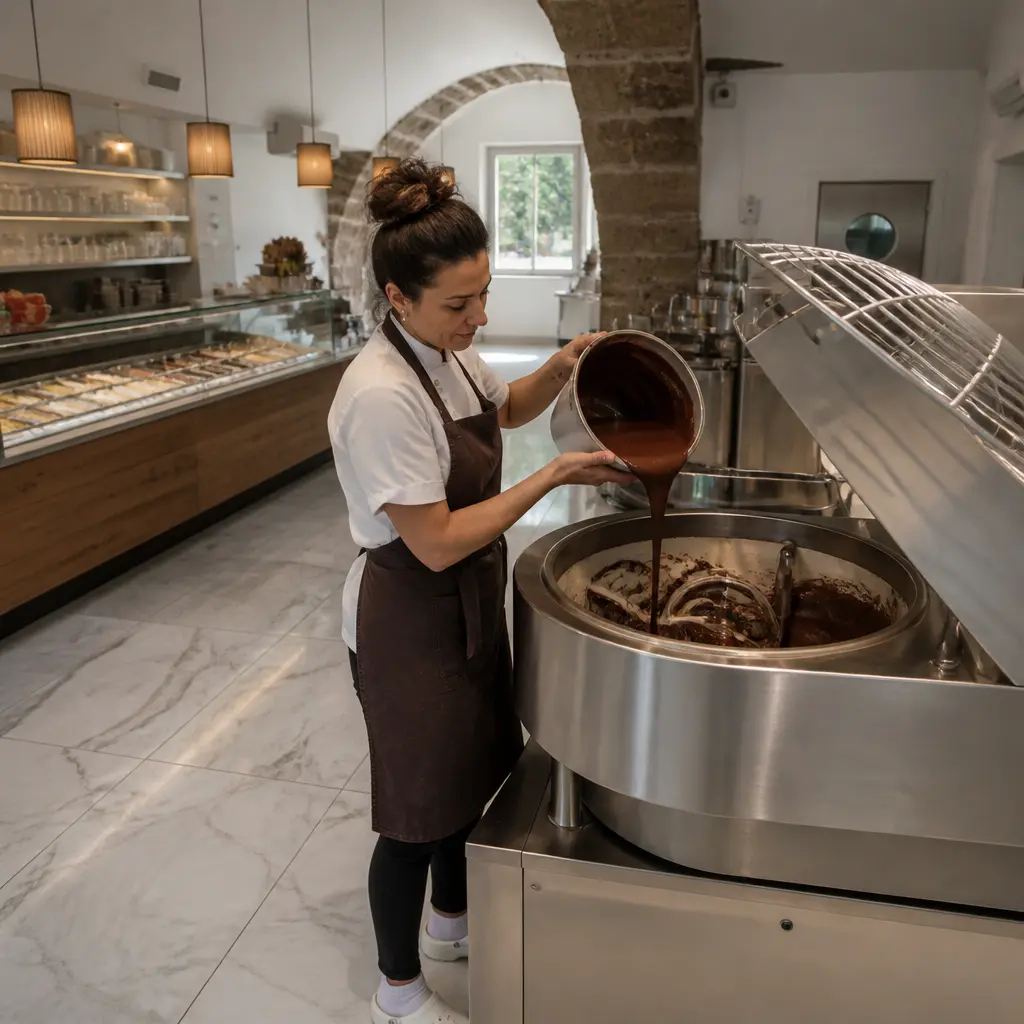
Stracciatella gelato is an Italian-style milk gelato defined by a smooth, relatively low-fat frozen base combined with thin shards of chocolate formed by pouring melted chocolate into the churning mixture. The traditional version uses real chocolate rather than cocoa-flavored syrup or preformed chips, allowing the chocolate to fracture into delicate flakes. This distinction matters because the technique, first associated with Enrico Panattoni’s 1961 creation at La Marianna in Bergamo, determines stracciatella’s characteristic contrast between creamy gelato and crisp chocolate. The sections below explain its definition, ingredient ratios, chocolate-shaving method, food-safety considerations, and a practical traditional recipe.
Stracciatella Gelato Uses Real Chocolate Shavings
The entity-attribute pairing “stracciatella gelato—real chocolate shavings” describes a milk-based gelato in which finely broken pieces of melted chocolate are distributed through the frozen base during churning. The name derives from the Italian verb stracciare, meaning “to tear” or “to shred,” which reflects the irregular flakes rather than uniform chocolate chips.
The most widely cited historical account comes from the La Marianna gelateria in Bergamo, where Enrico Panattoni developed stracciatella in 1961. The flavor was reportedly inspired by the Roman soup stracciatella, whose beaten egg forms ragged strands in hot broth. In gelato, the “ragged” element is chocolate: melted chocolate solidifies on contact with the cold mixture and breaks into shards.
Traditional stracciatella is therefore a hyponym of milk gelato, alongside fior di latte, crema, and other dairy-based flavors. Its defining subtype is not simply “vanilla gelato with chocolate”; it is gelato in which the chocolate inclusions are created during production.
Real Chocolate Versus Chocolate Chips
Real chocolate is a cocoa-derived product containing cocoa solids and cocoa butter, usually balanced with sugar and, in milk chocolate, milk ingredients. Chocolate chips are manufactured inclusions designed to retain their shape during baking, so they can taste harder and more prominent in a frozen dessert.
For a classic stracciatella texture, dark chocolate containing approximately 55% to 70% cocoa solids is a practical choice. Higher-cocoa chocolate generally supplies a more intense, less sweet flavor, while milk chocolate produces softer sweetness but can make the gelato taste less distinctly chocolate-forward.
The International Cocoa Organization describes cocoa butter as the fat naturally present in cocoa beans. That fat is important to the technique because it melts smoothly and then sets quickly when exposed to the cold gelato. The result is a thin fracture rather than a chewy lump.
Traditional Stracciatella Gelato as a Low-Overrun Dessert
Gelato typically contains less incorporated air than many commercial ice creams and is served at a slightly warmer temperature. Lower overrun gives the base a denser, more immediate flavor impression, while the warmer serving temperature helps the tongue perceive milk, sugar, and chocolate aromas.
The U.S. Food and Drug Administration defines ice cream under a standard that includes at least 10% milkfat, whereas “gelato” is not governed by one universally equivalent international legal definition. Consequently, recipes and commercial products vary by country. The useful sensory distinction is a dense, smooth frozen dessert with moderate fat and limited air, not a single legally fixed formula.
Traditional Stracciatella Gelato Balances Milk, Sugar, and Chocolate
A traditional base depends on balance rather than a large quantity of cream. Milk supplies water, lactose, protein, and minerals; cream contributes milkfat and richness; sugar sweetens the mixture and lowers its freezing point; and a small stabilizing element improves body and slows the formation of coarse ice crystals.
Ingredient Function and Working Ratios
The following home-scale formula makes approximately 1 quart, or about 950 milliliters, of gelato before storage losses. It is designed to produce a clean milk flavor that allows the chocolate to remain prominent.
- 600 grams whole milk
- 200 grams heavy cream
- 135 grams granulated sugar
- 35 grams skim milk powder
- 25 grams dextrose or light corn syrup, optional but useful for a softer scoop
- 1 gram fine sea salt
- 1 teaspoon vanilla extract or a small piece of vanilla bean, optional
- 90 to 110 grams dark chocolate for the shavings
This formulation contains roughly 14% added sugar by weight before considering lactose and the chocolate’s sugar. That level is a starting point, not a universal standard: chocolate sweetness, freezer temperature, and personal preference all affect the final result. Milk powder adds dairy solids without adding much water, helping the gelato feel fuller instead of icy.
Milk Gelato Base and Its Hyponyms
The base can be classified into several related styles. A fior di latte base emphasizes milk and cream with little or no egg. A vanilla crema base may include egg yolks, which add emulsifying phospholipids and a custard-like flavor. A stracciatella base can use either approach, but the milk-forward fior di latte style is especially suitable because it keeps the chocolate shavings visually and aromatically central.
Egg-free does not mean structure-free. Milk proteins, milk powder, sugar, and controlled churning collectively support smoothness. Professional recipes may also use small quantities of locust bean gum, guar gum, or another approved stabilizer. Home cooks can omit these ingredients, but the gelato should then be churned promptly and served within a few days for the best texture.
Real Chocolate Shavings Form During Churning
The defining production step is adding melted chocolate in a narrow stream near the end of churning. Because the gelato is cold and constantly moving, the chocolate sets almost immediately and is broken into irregular flakes by the dasher. This is fundamentally different from folding in solid chips after churning.
Preparing the Gelato Base
- Combine the sugar, skim milk powder, salt, and optional dextrose. Mixing the dry ingredients first reduces clumping.
- Heat the milk and cream in a saucepan. Whisk in the dry mixture gradually.
- Heat to approximately 82–85°C, stirring continuously. Do not boil vigorously, because excessive heating can produce cooked flavors and destabilize the dairy mixture.
- Cool the base rapidly in a covered container, then refrigerate it at 4°C or below for at least 4 hours, preferably overnight.
- Churn the thoroughly chilled mixture according to the machine manufacturer’s instructions.
The U.S. Food and Drug Administration identifies 4°C, or 40°F, as an important refrigeration threshold for perishable foods. Rapid cooling is especially relevant here because the base contains milk and cream and may remain in the temperature range where microorganisms multiply if it cools slowly.
Making Thin Chocolate Flakes
- Finely chop the chocolate and melt it gently over a bain-marie or in short microwave intervals.
- Stir until smooth. Avoid introducing water or steam, which can cause chocolate to seize.
- When the gelato is nearly finished, pour the chocolate in a very thin, steady stream through the machine’s opening.
- Continue churning for approximately 30 to 60 seconds, just long enough to distribute the flakes.
- Transfer the gelato to a shallow, freezer-safe container, press parchment or reusable wrap against the surface, cover, and harden for 2 to 4 hours.
Cocoa butter’s melting behavior explains why the stream must be thin. The International Cocoa Organization and food-science references commonly place cocoa butter’s melting range near body temperature, although the precise behavior depends on chocolate composition and tempering. A thin stream loses heat quickly against the frozen gelato, producing brittle flakes; a thick stream forms large slabs.
Chocolate-Flake Size as a Quality Indicator
Flake size is a practical quality indicator. Very fine particles create a uniform chocolate flavor but can disappear texturally. Large chunks create dramatic contrast but may become hard and distracting when deeply frozen. A useful target is a mixture of small shards roughly 1 to 5 millimeters across, with some finer fragments dispersed through the base.
If the chocolate remains soft or streaky, the gelato may be too warm, the chocolate stream may be too thick, or the chocolate may contain ingredients that lower its setting strength. If the pieces become excessively hard, reduce the chocolate quantity slightly, choose a chocolate with a balanced cocoa-butter content, or allow the finished gelato to temper briefly before serving.
Traditional Stracciatella Gelato Requires Controlled Freezing and Serving
Freezing quality depends on water management, temperature, and storage time. Ice crystals grow when the gelato warms and refreezes, so repeated temperature fluctuations can damage the smooth texture even when the recipe is correctly balanced.
Storage, Tempering, and Food Safety
- Store the gelato in a shallow, tightly covered container at approximately −18°C or colder.
- Keep the container toward the back of the freezer, where the temperature is more stable.
- Use a clean scoop and return the container to the freezer promptly.
- Temper the gelato in the refrigerator for 10 to 20 minutes or at room temperature for a shorter period before scooping.
- For best home quality, consume it within approximately 7 to 10 days, even though continuously frozen food may remain safe longer.
The U.S. Department of Agriculture emphasizes that freezing preserves food by slowing microbial activity but does not sterilize it. For this reason, the base should be cooled quickly, handled with clean equipment, and protected from contamination before and after churning.
Serving and Sensory Evaluation
Serve stracciatella in a chilled cup or cone with a portion size of approximately 75 to 100 grams. At that scale, the eater can perceive the milk base, the cooling effect of the frozen dessert, and the chocolate’s snap without overwhelming sweetness.
A well-made batch should show these characteristics:
- Appearance: pale ivory gelato with irregular dark chocolate flakes, not broad ribbons of chocolate paste.
- Aroma: fresh dairy notes followed by cocoa and vanilla, if used.
- Texture: dense and smooth, with brittle or lightly crisp chocolate shards.
- Flavor: balanced sweetness, moderate dairy richness, and a clean chocolate finish.
Traditional Stracciatella Gelato Connects History With Craft
Stracciatella’s importance lies in its simplicity: a short ingredient list makes technique visible. The flavor’s history at La Marianna links it to postwar Italian gelateria, while its name connects the irregular chocolate fragments to the torn strands of Roman stracciatella soup. Modern commercial versions may use chocolate flakes, compound coatings, syrups, or inclusions added after freezing, but the traditional method remains recognizable by its poured-and-fractured chocolate.
For home makers, the most useful improvement is precision. Weigh the ingredients, chill the base quickly, use real chocolate, and add it only when the gelato is nearly churned. A simple kitchen thermometer and a digital scale provide more reliable results than volume measurements alone.
Conclusion: Stracciatella Gelato—Real Chocolate Shavings Define the Classic
Traditional stracciatella gelato is a milk-forward gelato whose defining attribute is real chocolate poured into the churning base to create irregular shavings. Its related forms include fior di latte and crema-based gelati, but the signature contrast comes from the chocolate’s rapid setting and fracture. Balanced dairy solids, sugar, controlled freezing, hygienic handling, and a thin chocolate stream produce the dense texture and crisp inclusions associated with the classic.
To explore the topic further, compare dark chocolates with different cocoa percentages, record the finished gelato’s texture at several serving temperatures, and consult professional gelato-making texts for solids, sweetness, and stabilizer calculations. The most meaningful test remains sensory: the gelato should taste clearly of fresh milk and cocoa, with chocolate shavings that break cleanly rather than clump.
Sources: La Marianna Gelateria, History of Stracciatella Gelato, https://www.lamarianna.it/; International Cocoa Organization, Cocoa and Chocolate Information, https://www.icco.org/; U.S. Food and Drug Administration, 21 CFR 135.110 Ice Cream and Related Frozen Desserts, https://www.ecfr.gov/current/title-21/chapter-I/subchapter-B/part-135/section-135.110; U.S. Food and Drug Administration, Food Safety and Perishable Foods, https://www.fda.gov/consumers/consumer-updates/food-safety-home; U.S. Department of Agriculture, Freezing and Food Safety, https://www.fsis.usda.gov/food-safety/safe-food-handling-and-preparation/food-safety-basics/freezing; Goff and Hartel, Ice Cream, 7th Edition, Springer, https://link.springer.com/book/10.1007/978-1-4615-0163-3