
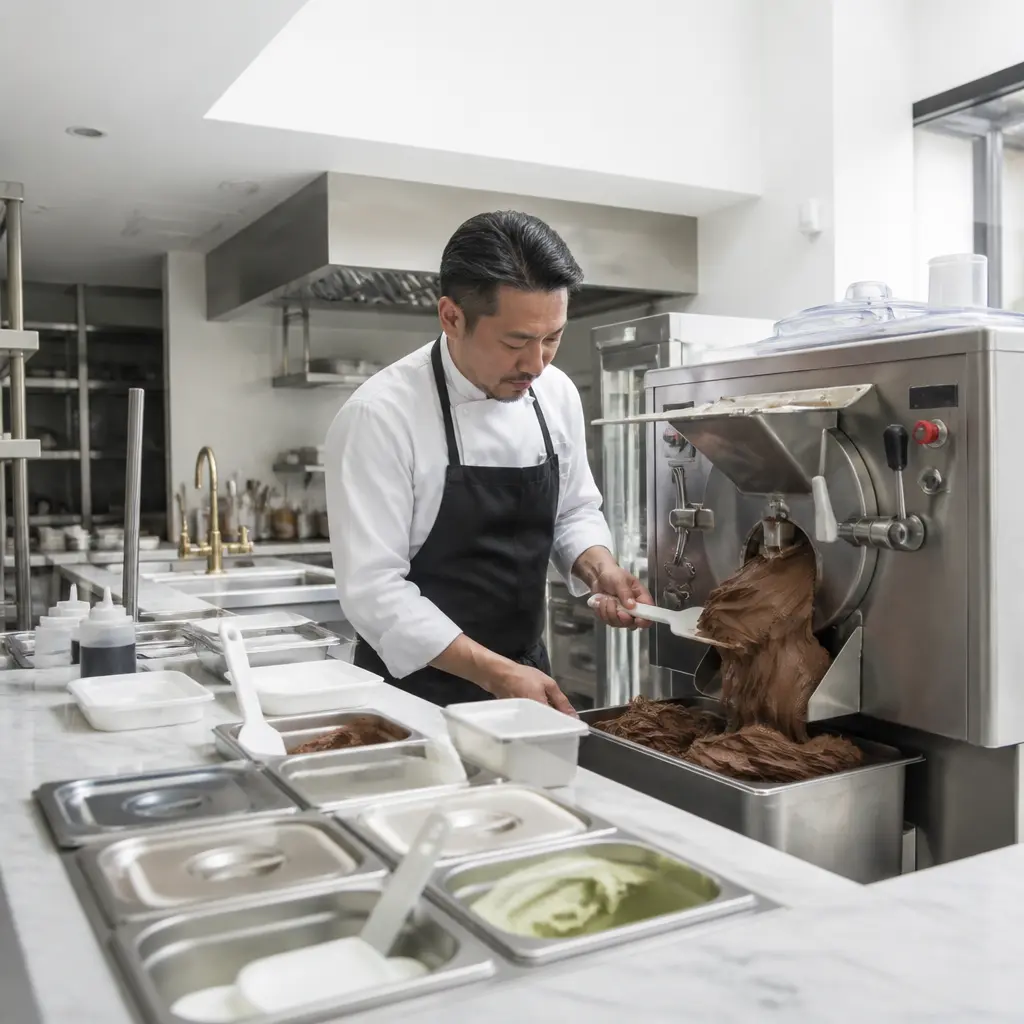
Rich dark chocolate gelato is a low-overrun frozen dessert defined by an intense cocoa profile, a dense yet scoopable texture, and a clean finish that avoids excessive sweetness or iciness. A professional result depends on balancing cocoa solids, sugar, dairy, emulsification, freezing temperature, and controlled air incorporation. The recipe below uses approximately 70–75% dark chocolate, unsweetened cocoa, and a restrained overrun to create a concentrated chocolate flavor; it also explains why serving temperature, particle size, and storage matter. The U.S. Department of Agriculture’s FoodData Central identifies dark chocolate as a concentrated source of energy and fat, while professional gelato practice emphasizes formulation and temperature control because small changes in sugar and fat can significantly affect hardness, body, and melt.
Rich Dark Chocolate Gelato—Professional Finish
The entity-attribute pairing “rich dark chocolate gelato—professional finish” describes gelato whose principal sensory attribute is deep, roasted cocoa flavor supported by a smooth, dense, rapidly melting structure. Food writer and pastry educator Harold McGee explains in On Food and Cooking that frozen desserts depend on managing ice crystals, dissolved sugars, fat, and air. In practical terms, a professional finish is not simply a darker color: it is the combined result of balanced sweetness, fine ice crystals, stable emulsion, moderate overrun, and an aftertaste that remains chocolate-forward rather than greasy or sugary.
Definition and sensory characteristics
Rich dark chocolate gelato is a milk- or cream-based frozen dessert flavored with dark chocolate and often cocoa powder. Compared with American-style ice cream, gelato generally contains less air and is served slightly warmer, which makes its texture feel denser and its flavor more immediate. A finished batch should appear glossy or satin-like, spread smoothly across the palate, and melt without waxiness or visible ice crystals.
- Flavor: roasted cocoa, mild bitterness, vanilla-like aromatic notes, and enough sugar to prevent harshness.
- Texture: compact, creamy, and smooth rather than fluffy.
- Color: dark brown with a natural variation based on cocoa type and chocolate percentage.
- Finish: clean and persistent, without a powdery cocoa sensation or fatty coating.
Hyponyms and related frozen desserts
Several related desserts fall under the broader category of chocolate frozen desserts, but they are not interchangeable. Dark chocolate gelato is dairy-based and relies on milk proteins and fat for body. Chocolate ice cream typically incorporates more cream and air. Chocolate sorbetto is dairy-free and obtains its structure from water, sugar, cocoa, and sometimes melted chocolate. Semifreddo contains more whipped air and is served with a softer, mousse-like texture. Chocolate granita is coarser and crystalline by design. Identifying these hyponyms clarifies why a gelato formula should not be judged by the standards of a custard ice cream or a water-based sorbet.
Cocoa Intensity—Dark Chocolate Gelato
Cocoa intensity is the attribute created by the concentration and quality of chocolate liquor, cocoa solids, cocoa butter, and volatile aroma compounds. A useful professional range is 70–75% dark chocolate combined with 5–8% unsweetened cocoa powder by total mix weight. Chocolate percentage indicates the proportion of cocoa-derived ingredients, not a direct measure of bitterness or quality; two chocolates with the same percentage can differ considerably in acidity, roast level, sugar, and cocoa origin.
Choosing chocolate and cocoa
For a balanced gelato, choose couverture or high-quality eating chocolate with a clear cocoa aroma and no pronounced burnt or smoky notes. A 70% chocolate usually provides enough depth without requiring excessive sugar correction. Unsweetened natural cocoa can contribute acidity and fruitiness, whereas Dutch-process cocoa tends to provide a darker color and rounder, less acidic profile. Combining the two is possible, but the formula should be tested because cocoa powders vary in fat content and particle size.
Chocolate also contributes cocoa butter, which firms as it cools. Excessive chocolate can make the gelato waxy or difficult to scoop, particularly when stored below approximately −18°C. The goal is not maximum chocolate by weight; it is maximum chocolate impact with a smooth melt.
Professional base formula
The following formula produces about 1 kilogram of mix, enough for roughly 1.2 liters of finished gelato depending on overrun and density.
- Whole milk: 560 grams
- Heavy cream: 160 grams
- 70–75% dark chocolate, finely chopped: 180 grams
- Granulated sugar: 105 grams
- Dextrose or glucose powder: 35 grams
- Unsweetened cocoa powder: 45 grams
- Skim milk powder: 35 grams
- Fine sea salt: 2 grams
- Pure vanilla extract or vanilla paste: 3 grams
The combined sugars improve sweetness, freezing control, and scoopability. Dextrose is less sweet than sucrose but has a strong effect on freezing behavior. Skim milk powder adds milk proteins and lactose solids, helping bind water and improve body without adding much fat. Because chocolate brands differ, the formula should be treated as a calibrated starting point rather than an immutable percentage chart.
Emulsion and Texture—Rich Dark Chocolate Gelato
Emulsion quality is the attribute that joins the water phase, dairy fat, cocoa particles, and melted chocolate into a stable mix. Without adequate dispersion, cocoa can settle, chocolate can seize, and the finished gelato may feel gritty or greasy. The Institute of Culinary Education and professional gelato training programs commonly emphasize heating, blending, aging, and rapid chilling as sequential controls rather than optional steps.
Cooking and blending method
- Whisk the sugar, dextrose, cocoa powder, skim milk powder, and salt together while dry. This disperses the cocoa and reduces clumping.
- Heat the milk and cream in a saucepan until steaming. Whisk in the dry ingredients gradually.
- Heat the mixture to approximately 82–85°C, stirring continuously. Do not boil vigorously, since scorching milk solids or reducing the mix excessively can damage flavor and texture.
- Remove the pan from the heat and add the chopped chocolate. Rest for one minute, then blend with an immersion blender until completely smooth.
- Add vanilla, transfer the mix to a shallow container, cover the surface, and chill rapidly to below 4°C.
- Age the base in the refrigerator for 4–12 hours before churning. Aging allows proteins and stabilizing solids to hydrate and the fat to partially crystallize.
Ice-crystal control and overrun
Ice-crystal control means limiting both crystal size and crystal growth during freezing and storage. Smaller crystals create the perception of smoothness. A home ice-cream machine generally introduces more air than a commercial gelato batch freezer, but the finished dessert should still feel compact rather than whipped. A practical target is approximately 20–30% overrun, meaning the frozen product contains about 20–30% more volume than the unfrozen mix. Commercial ice cream may use substantially more air, which is one reason gelato tastes denser.
Churn the aged base until it reaches a soft-serve consistency, usually 20–30 minutes in a home machine, although equipment and batch size change the timing. Pack it into a shallow, chilled container and press parchment or plastic wrap directly against the surface. Rapid hardening reduces the time available for large crystals to form.
Serving Temperature—Professional Dark Chocolate Gelato
Serving temperature is the attribute that determines whether the formula expresses its intended aroma and texture. Gelato is commonly served warmer than hard-frozen ice cream, often around −12 to −14°C, while a storage freezer may sit near −18°C or colder. At the warmer serving range, fat softens, sugar remains more effective as a plasticizer, and volatile chocolate aromas reach the nose more readily.
Storage and service protocol
- Use a shallow, lidded container rather than a deep tub to accelerate hardening.
- Keep the container toward the back of the freezer, where temperature changes are smaller.
- Allow the gelato to temper for approximately 5–10 minutes before scooping, depending on freezer temperature and container depth.
- Minimize repeated warming and refreezing, which encourages recrystallization and a rougher texture.
- For the best sensory quality, consume a home batch within one to two weeks, even though it may remain safe for longer when continuously frozen.
Finishing elements and presentation
A professional finish should reinforce the cocoa rather than conceal it. Serve a small quenelle or compact scoop in a chilled cup, then add one restrained contrast: cocoa nibs for crunch, a few flakes of finishing salt, shaved dark chocolate, or a thin espresso syrup. Avoid wet toppings in the storage container because free water can create icy pockets. A visual process chart would show the ideal sequence as cocoa dispersion, controlled heating, high-shear blending, rapid chilling, aging, churning, and hardening; skipping any one of these stages can affect the final result.
Troubleshooting—Rich Dark Chocolate Gelato
If the gelato is icy
Icy texture usually indicates too much unbound water, insufficient sugar or milk solids, slow freezing, or temperature fluctuation. Check that the base was chilled quickly, the machine was fully frozen if required, and the gelato was transferred to a shallow container immediately after churning. A modest increase in dextrose or skim milk powder may improve scoopability, but excessive adjustment can make the gelato sticky or overly sweet.
If the gelato is waxy or greasy
Waxy texture commonly results from too much cocoa butter, excessive chocolate, inadequate blending, or serving at an overly cold temperature. Reduce the chocolate slightly in the next batch, use a chocolate with a smoother melt, and blend the hot base thoroughly. Tempering the container briefly before serving can reveal whether the problem is formulation or temperature.
If the flavor is bitter or flat
Bitterness can come from highly roasted cocoa, very dark chocolate, overcooked milk, or insufficient sugar. Flatness may indicate low-quality chocolate, too much dairy dilution, or a lack of salt and vanilla. Taste the liquid base before freezing, remembering that cold suppresses sweetness and aroma. Adjusting the balance before churning is more effective than trying to correct the frozen product afterward.
Conclusion—Dark Chocolate Gelato With a Professional Finish
Rich dark chocolate gelato achieves its professional finish through coordinated attributes: cocoa intensity supplies depth, emulsion supplies smoothness, controlled overrun supplies density, and serving temperature releases aroma. A 70–75% chocolate, measured sugar system, blended dairy base, rapid chilling, overnight aging, and prompt hardening provide a dependable method for home or small-scale production. The broader lesson is that excellent frozen desserts are formulated systems rather than collections of ingredients. For further refinement, compare chocolate origins, record mix temperatures and churning times, and evaluate each batch for sweetness, melt rate, ice-crystal perception, and aftertaste.
Sources: U.S. Department of Agriculture, FoodData Central, https://fdc.nal.usda.gov/; McGee, Harold, On Food and Cooking: The Science and Lore of the Kitchen, Scribner, https://www.culinarystudents.org/foodscience/On%20Food%20and%20Cooking.pdf; Institute of Culinary Education, Chocolate and Frozen Dessert Technique Resources, https://www.ice.edu/; Carpigiani Gelato University, Gelato Science and Training Resources, https://www.gelatouniversity.com/; U.S. Food and Drug Administration, Food Safety and Temperature Guidance, https://www.fda.gov/food