Sicilian fig-and-honey pairings are Mediterranean combinations in which the fruit’s jammy sweetness, floral aroma, and gentle acidity are balanced by honey, cheese, nuts, citrus, or wine. Sicilian makers most often build these pairings around fresh or dried common figs, prickly pears, ricotta, tuma or pecorino, toasted almonds, sesame, and local honeys such as zagara, sulla, chestnut, and millefiori. Their importance is both culinary and economic: the Food and Agriculture Organization identifies figs as a major Mediterranean fruit crop, while Italy remains a significant European honey producer and Sicily preserves a particularly diverse tradition of citrus-blossom and wildflower honeys.
Sicilian makers define fig-and-honey pairings through contrast and locality
A Sicilian fig-and-honey pairing is a composed food combination in which a fig variety and a honey variety are selected for complementary sweetness, aroma, texture, and regional identity. In sensory terms, the pairing works because figs contribute soft flesh, seed crunch, concentrated fruit sugars, and sometimes berry-like acidity, while honey contributes a smoother sweetness and a distinct floral or herbal top note. The Sicilian beekeeping tradition adds further variation through nectar sources, including citrus orchards, sulla fields, eucalyptus, chestnut woods, and mixed Mediterranean vegetation.
The main hyponyms are fresh-fig pairings, dried-fig pairings, pastry and preserve pairings, and savory cheese pairings. Each category uses a different balance. Fresh figs need a light, aromatic honey; dried figs need acidity, spice, or a salty counterpoint; preserves need a honey that does not obscure the fruit; and cheese plates benefit from darker or more resinous honeys that can stand beside aged dairy.
Fresh figs with zagara honey and ricotta
Zagara honey is produced from the blossoms of citrus trees, especially orange and lemon trees. It is generally valued for a bright floral fragrance and a clean, lightly citrus-like finish. Sicilian makers use it with ripe fresh figs because the honey reinforces the fig’s perfume without adding the heavier molasses or malt notes associated with some darker honeys.
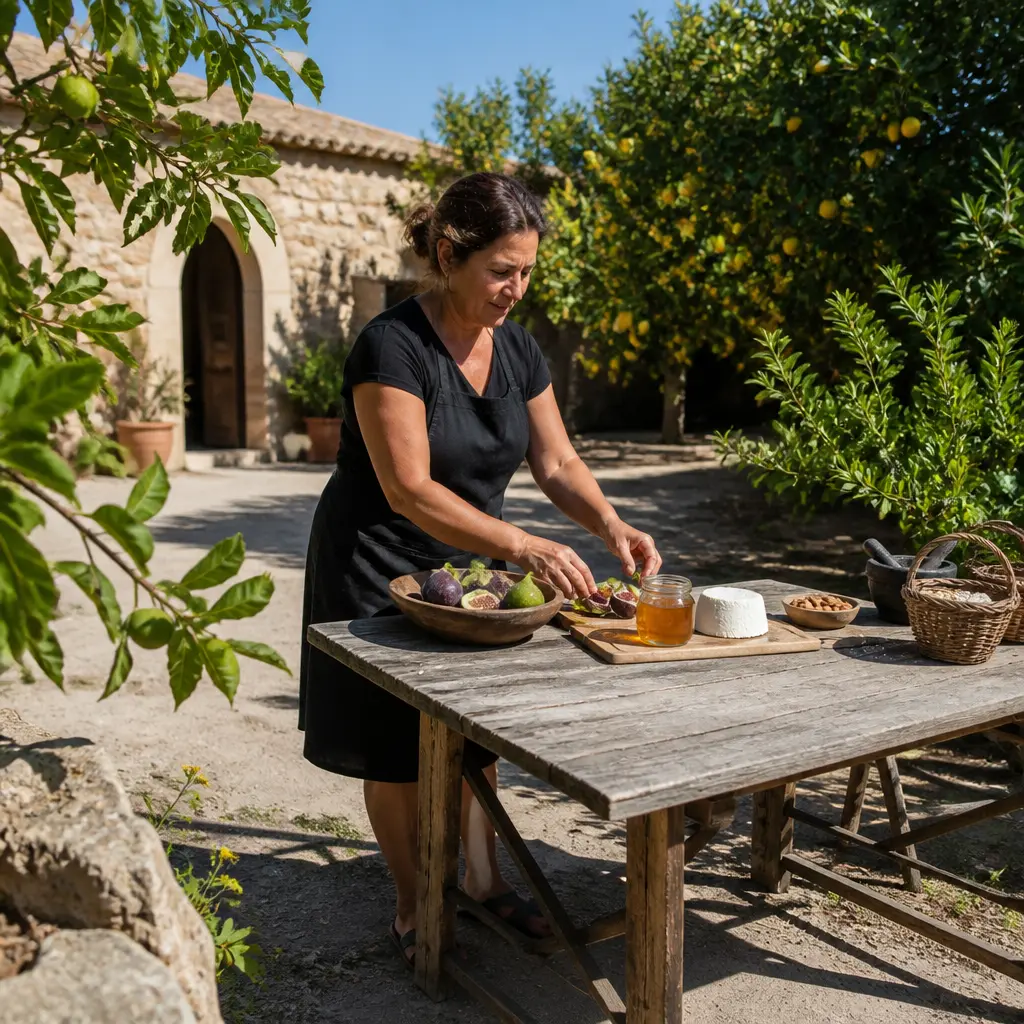
A classic serving combines halved figs, sheep’s-milk ricotta, zagara honey, and toasted almonds or pistachios. The ricotta supplies creamy protein and mild lactic acidity, the nuts add crunch, and the citrus-blossom honey connects the dairy to the fruit. This is also a useful model for breakfast dishes, semifreddo, panna cotta, and simple plated desserts. The Italian Council for Agricultural Research and Analysis of Agricultural Economics, commonly known as CREA, lists ricotta and figs among foods whose composition makes them useful sources of energy, natural sugars, and dairy protein, although the final nutritional profile changes substantially when honey and nuts are added.
Fresh figs with sulla honey and soft cheese
Sulla honey comes from sulla, a Mediterranean legume also known as sainfoin. It is typically pale, delicate, and gently vegetal, making it suitable for fresh figs that are ripe but not overripe. Sicilian cheesemakers and food artisans may serve this combination with fresh tuma, primo sale, or a young pecorino, where the honey’s restrained character preserves the cheese’s milkiness.
The pairing illustrates a broader Sicilian principle: mild honeys are used where the maker wants the fig to remain the dominant flavor. A small drizzle is more effective than a heavy pour because figs already contain substantial natural sugar. For a tasting board, two or three fig halves per person, a modest portion of cheese, and a teaspoon of honey provide enough contrast without turning the course into a dessert.
Dried figs and robust honeys create Sicilian pantry pairings
Drying concentrates the fig’s sugars, minerals, aroma, and chewy texture, so dried-fig pairings require more than additional sweetness. Sicilian producers commonly balance them with toasted almonds, walnuts, sesame, orange zest, cinnamon, black pepper, or a firm aged cheese. The most effective honey depends on whether the finished product is intended as confectionery, a preserved fruit, or a savory accompaniment.
Dried figs with chestnut honey and aged pecorino
Chestnut honey is darker and more assertive than citrus-blossom honey, with bitter, woody, and malty notes. Those characteristics help it balance the dense sweetness of dried figs. A Sicilian-style tasting can pair a dried fig with aged pecorino, chestnut honey, and a few roasted walnuts. The cheese contributes salt and umami, the walnuts add tannic bitterness, and the honey supplies a rounded finish.
This combination is best understood as a hyponym of the savory fig-and-honey pairing rather than as a dessert alone. It can accompany an aperitivo, a cheese course, or a seasonal antipasto. The Italian National Institute for Statistics and agricultural reporting bodies distinguish honey by production and market categories rather than by flavor intensity, so sensory descriptions such as “dark,” “woody,” or “bitter” should be treated as tasting guidance, not official quality grades.
Dried figs with sesame, almonds, and millefiori honey
Millefiori honey is made from nectar gathered from multiple flowers, so its character varies by landscape and season. In Sicily, a millefiori honey can reflect herbs, field flowers, citrus, and other plants found around orchards and dry Mediterranean farmland. Makers use it in fig-and-nut sweets because it offers enough fragrance to bind the ingredients while remaining less dominant than chestnut or eucalyptus honey.
A practical preparation is to open a dried fig, fill it with an almond or walnut, brush it with a small amount of honey, and finish it with sesame. The sesame creates a roasted note familiar from several Sicilian confectionery traditions, while the dried fruit provides a soft center. If the figs are very sweet, a few drops of lemon juice or a little grated orange peel can supply the acidity that honey alone cannot provide.
Sicilian pastry makers turn fig-and-honey combinations into preserves and desserts
In pastry, fig and honey are usually treated as flavor architecture rather than equal-volume ingredients. Fig jam, mostarda-style preserves, compotes, fillings, and baked sweets use the fruit for body and color, then add honey for floral lift or a softer finish. This distinction matters because prolonged heating changes honey’s aroma, while excessive cooking can flatten the fresh character of figs.
Fig preserves with lemon, orange, and zagara honey
A preserve made from ripe figs, citrus zest, and zagara honey belongs to the bright preserve category. Lemon juice helps set the flavor into sharper focus, while orange zest echoes the honey’s blossom source. The mixture works in crostate, layered cakes, filled biscuits, or alongside ricotta.
Food-safety practice is essential for home and small-scale production. The United States Department of Agriculture emphasizes tested recipes, correct acidity, appropriate heat processing, and clean jars for shelf-stable preserves. Honey should not be given to infants under twelve months, a safety warning also maintained by the U.S. Centers for Disease Control and Prevention.
Fig, honey, and chocolate or coffee
Dark chocolate and coffee are compatible with dried figs because their bitterness offsets concentrated fruit sugar. Makers generally choose a floral millefiori or a restrained chestnut honey rather than a highly perfumed citrus honey. The combination appears naturally in filled chocolates, ganache, biscuits, and modern versions of Sicilian almond-based sweets.
The useful rule is to match intensity: delicate fresh figs call for light honey and mild dairy, while dried figs, cocoa, espresso, and toasted nuts can support stronger honey. A simple sensory chart would place fresh fig with zagara and sulla honey in the “light and floral” range, dried fig with millefiori in the “fruity and rounded” range, and dried fig with chestnut honey and aged pecorino in the “dark, salty, and savory” range.
Prickly pear and fig pairings broaden the Sicilian interpretation
Sicilian food culture also uses the word fig in connection with fico d’India, the prickly pear. Botanically, prickly pear is not the same fruit as the common fig, but it is an important Sicilian crop and a frequent source of confusion in discussions of Mediterranean fig pairings. Its vivid red, orange, or yellow pulp is more watery and tangy than dried common fig, so it works particularly well with mild honey, lemon, fresh cheese, and herbs.
Prickly pear with citrus honey and fresh dairy
Prickly pear wedges or strained pulp can be served with zagara honey, ricotta, yogurt, or a fresh sheep’s-milk cheese. The citrus-flower aroma reinforces the fruit’s freshness, while dairy softens its seeds and acidity. The European Union recognizes the agricultural and cultural value of Sicilian prickly pear through protected-origin and traditional-product frameworks associated with Sicilian cultivation areas.
This pairing is especially effective in granita, chilled creams, fruit salads, and breakfast bowls. It should not be described as an ordinary fig pairing in a product label, however: clear naming helps consumers distinguish common fig preserves from prickly-pear preparations and supports accurate regional storytelling.
How to taste and buy Sicilian fig-and-honey combinations
To compare combinations fairly, taste the fig first, then the honey alone, and finally the two together with the proposed cheese or nut. Look for three outcomes: whether the honey amplifies the fruit’s aroma, whether its sweetness overwhelms the fig, and whether the finish gains acidity, bitterness, saltiness, or spice. Sicilian makers often favor local traceability, so a jar should identify the honey’s floral source when possible and a packaged fig product should state whether it uses fresh figs, dried figs, or prickly pear.
- Choose zagara honey for fresh figs, ricotta, citrus desserts, and light pastries.
- Choose sulla honey for fresh figs with young cheeses and mild breakfast dishes.
- Choose millefiori honey for dried figs, almonds, sesame, biscuits, and preserves.
- Choose chestnut honey for dried figs, aged pecorino, walnuts, cocoa, and coffee.
- Use eucalyptus or strongly aromatic honeys sparingly, since their medicinal or menthol-like notes can dominate delicate fruit.
Conclusion: Sicilian fig-and-honey pairings preserve Mediterranean craft
Sicilian makers’ favorite combinations are governed by a clear logic of balance. Fresh figs pair most naturally with zagara or sulla honey, ricotta, young cheese, and almonds; dried figs need the deeper support of millefiori or chestnut honey, nuts, sesame, citrus, and aged pecorino; and prickly pear offers a related but botanically distinct route into bright honey-and-fruit desserts. These pairings matter because they connect beekeeping, orchard agriculture, cheesemaking, pastry, and regional identity in a form that is easy to taste and reproduce.
For further exploration, compare three honeys from different nectar sources with the same Sicilian fig, record aroma and finish, and then repeat the tasting with ricotta or pecorino. Reading producer labels, protected-origin documentation, and food-safety guidance will help consumers appreciate both the craft and the practical standards behind these Mediterranean combinations.
Sources: Food and Agriculture Organization of the United Nations, FAOSTAT Crops and Livestock Products, https://www.fao.org/faostat/en/#data/QCL; CREA, Food Composition Database, https://www.alimentinutrizione.it/tabelle-nutrizionali; Italian Ministry of Agriculture, Food Sovereignty and Forestry, Traditional Agri-Food Products, https://www.masaf.gov.it/; European Commission, eAmbrosia Geographical Indications Register, https://ec.europa.eu/agriculture/eambrosia/geographical-indications-register/; United States Department of Agriculture, Complete Guide to Home Canning, https://nchfp.uga.edu/how/can; Centers for Disease Control and Prevention, About Botulism, https://www.cdc.gov/botulism/about/index.html